Neil Patel’s “B2B Marketing Strategies: A Complete Guide” is a practical map of modern digital promotion. It recommends defining an ideal customer, setting measurable goals, choosing a few channels, creating useful content and connecting marketing activity to revenue. As an introduction to digital demand generation, it is clear and usable.
The problem is the label. The guide repeatedly moves between “B2B marketing” and “B2B digital marketing” as though they are interchangeable. Content, SEO, email, LinkedIn ads and webinars are ways to create and capture attention. B2B marketing is the larger commercial discipline that decides what a company should mean in its market, which customers it can serve profitably, why those customers should change and what the business must prove. Channels can support that system, but they cannot substitute for one.
A company can execute every tactic in the guide and still have a weak B2B strategy. It can rank for valuable keywords while offering no credible reason to choose it. It can collect thousands of gated-content leads that sales will never accept. It can target the correct job titles while misunderstanding who holds budget, who carries implementation risk and who can quietly veto the purchase. More activity does not repair unclear positioning or an offer that is difficult to buy.
The article acknowledges that a procurement team may contain twelve people and that the journey is nonlinear, yet its prescriptions remain mostly individual: someone finds a search result, downloads an ebook or attends a webinar, then marketing nurtures that person toward conversion. The harder task is helping a group agree. Gartner’s description of B2B buying includes requirements building, validation and consensus creation. Those jobs need more than promotional content. A champion may need an economic case for finance, an implementation argument for operations and a security answer for IT.
The channel recommendations are also too universal. LinkedIn, Google Ads and SEO can be excellent, but the right route to market depends on deal value, sales complexity, buyer concentration and cost to serve. A self-service software company selling to millions of small firms has a different marketing problem from a manufacturer pursuing twenty infrastructure contracts. McKinsey’s 2024 B2B Pulse found buyers dividing their preferences among in-person, remote and digital self-service engagement. Digital matters, but it must connect coherently with sales, commerce and service.
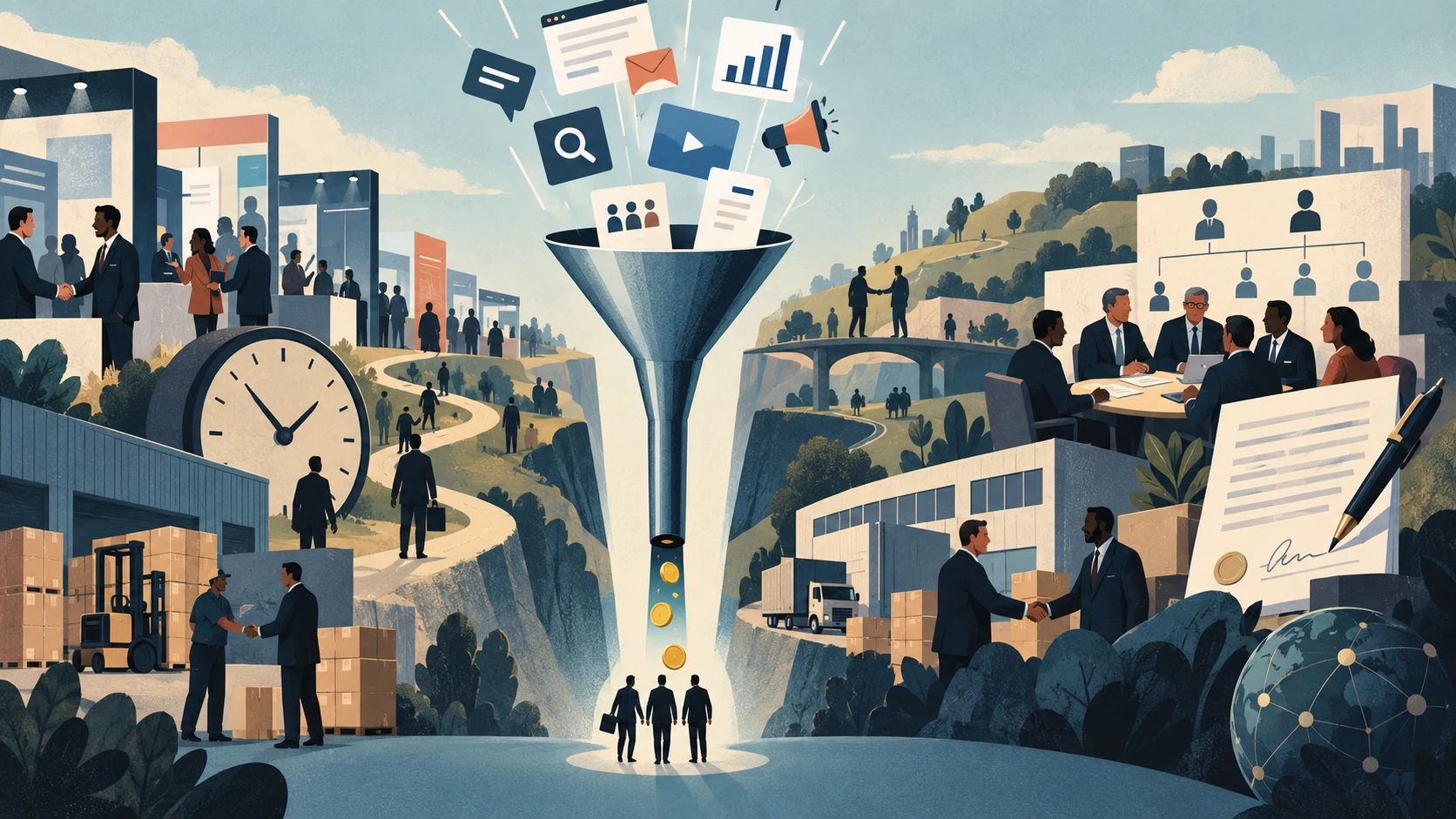
The guide’s funnel creates a related blind spot. Mapping blogs to awareness and landing pages to decisions makes planning tidy, but most potential customers are not ready to buy. The B2B Institute’s 95-5 rule is a useful corrective: marketing must help active buyers progress while also building memory among future buyers who have no reason to enter a nurture sequence today.
What is missing, then, is not another tactic. Positioning gives content a distinctive argument. Product marketing turns capabilities into a reason to change. Sales enablement helps a buying group reach confidence. Pricing, proof, onboarding and customer experience shape demand and lifetime value more profoundly than another subject-line test.
The guide is useful, but it is a digital-demand checklist rather than a complete account of B2B marketing. The addendum is to reverse the order of work: start with the market, the customer’s reason to change, the buying group’s unresolved tasks and the economics of the sales motion. Decide what marketing must accomplish before deciding where it will appear. Channels distribute a B2B strategy. They are not the strategy itself.