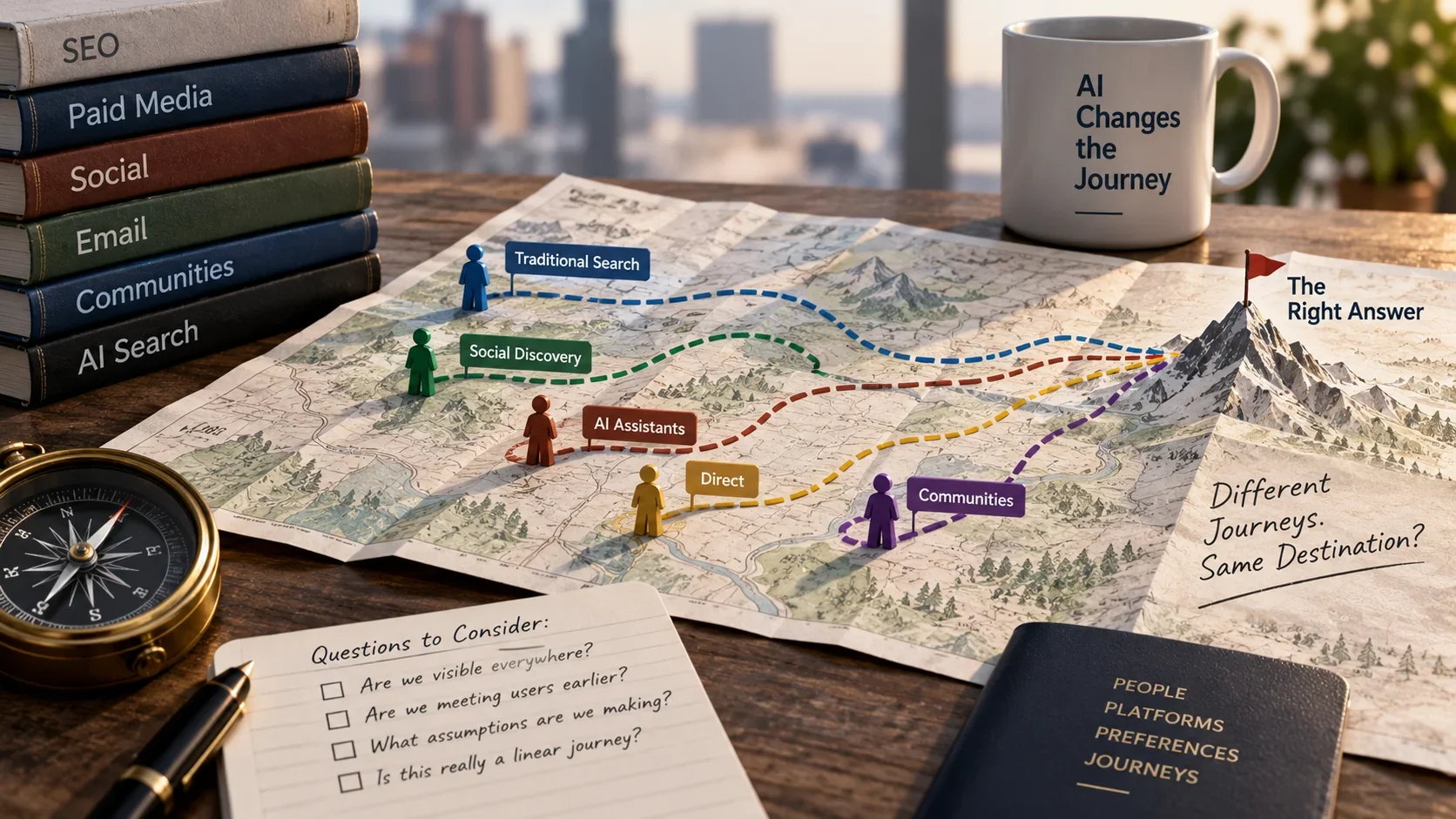
In “AEO Is Creating New Blind Spots in Customer Demand”, Gartner argues that traffic and click data reveal less of the customer journey as answer engines satisfy more questions without a website visit. The article recommends pairing established business measures with Share of Answer, citation presence, brand mention frequency and sentiment, and AEO-influenced conversions. The goal is a hybrid view of demand across websites and AI-mediated experiences.
The premise is sound. A click was always an imperfect proxy for attention or intent, and now it also misses interactions that happen entirely inside an answer engine. Marketers should not diagnose every organic traffic decline as lost demand. They need some way to investigate whether discovery moved elsewhere and whether their brand is represented accurately when it does.
But most of the proposed AEO metrics observe the machine, not the customer. Share of Answer records how often a brand appears across a selected collection of prompts and responses. That can reveal how a model represents a category, but it does not show how often real people asked those questions, which audiences asked them, whether they noticed the brand, or whether the answer changed a decision. Without those links, Share of Answer is closer to a synthetic impression count than a demand signal.
Citation presence has the same problem. A model may cite a company’s research while recommending a competitor, bury the citation where few users inspect it, or use the source to answer a question with no commercial intent. Conversely, a brand may influence an answer without receiving a visible citation. Counting references is useful for diagnosing content availability, but calling that influence gives the metric more meaning than the observed event can support.
Brand mention frequency and sentiment add another layer of apparent precision. Results can vary by model, subscription tier, location, personalization, prompt wording, and product update. A dashboard can assign a clean score to a sample that is neither stable nor representative. Unless marketers disclose which prompts were tested, how they were weighted, how often the tests ran, and how variation was handled, competitors can report incompatible numbers that all look authoritative.
“AEO-influenced conversions” is the one proposed measure that approaches business value, yet it is also the hardest to establish. Zero-click journeys remove the referral trail that would make attribution straightforward. A later direct visit or branded search might follow an AI answer, an advertisement, a colleague’s recommendation, or prior familiarity. Self-reported surveys, panels, controlled experiments, brand-lift studies, and probabilistic models can narrow that uncertainty, but none should be hidden behind a single confident label.
There is also a predictable management risk. Once these measures become targets, teams will optimize prompt lists, mentions, and citation-friendly content because those are the numbers visible in the dashboard. The old traffic vanity metric then returns in machine-readable form. A company can gain answer share without gaining customers, just as it once gained page views without gaining revenue.
Gartner is right to recommend hybrid measurement, but the two tracks need a clearer hierarchy. Machine visibility metrics should be treated as diagnostic indicators: can an answer engine retrieve and represent the brand? Human evidence should test exposure, recall, trust, and preference. Business measures should then test incremental behavior and economic value. Each layer answers a different question, and uncertainty should remain visible when the layers cannot be connected.
The addendum is simple: new visibility deserves new measurement, but not every measurable model output is evidence of customer demand. AEO reporting becomes useful when it distinguishes machine availability from human influence and proves the connection where possible. Otherwise, the customer remains missing from the very dashboard designed to reveal the journey.